
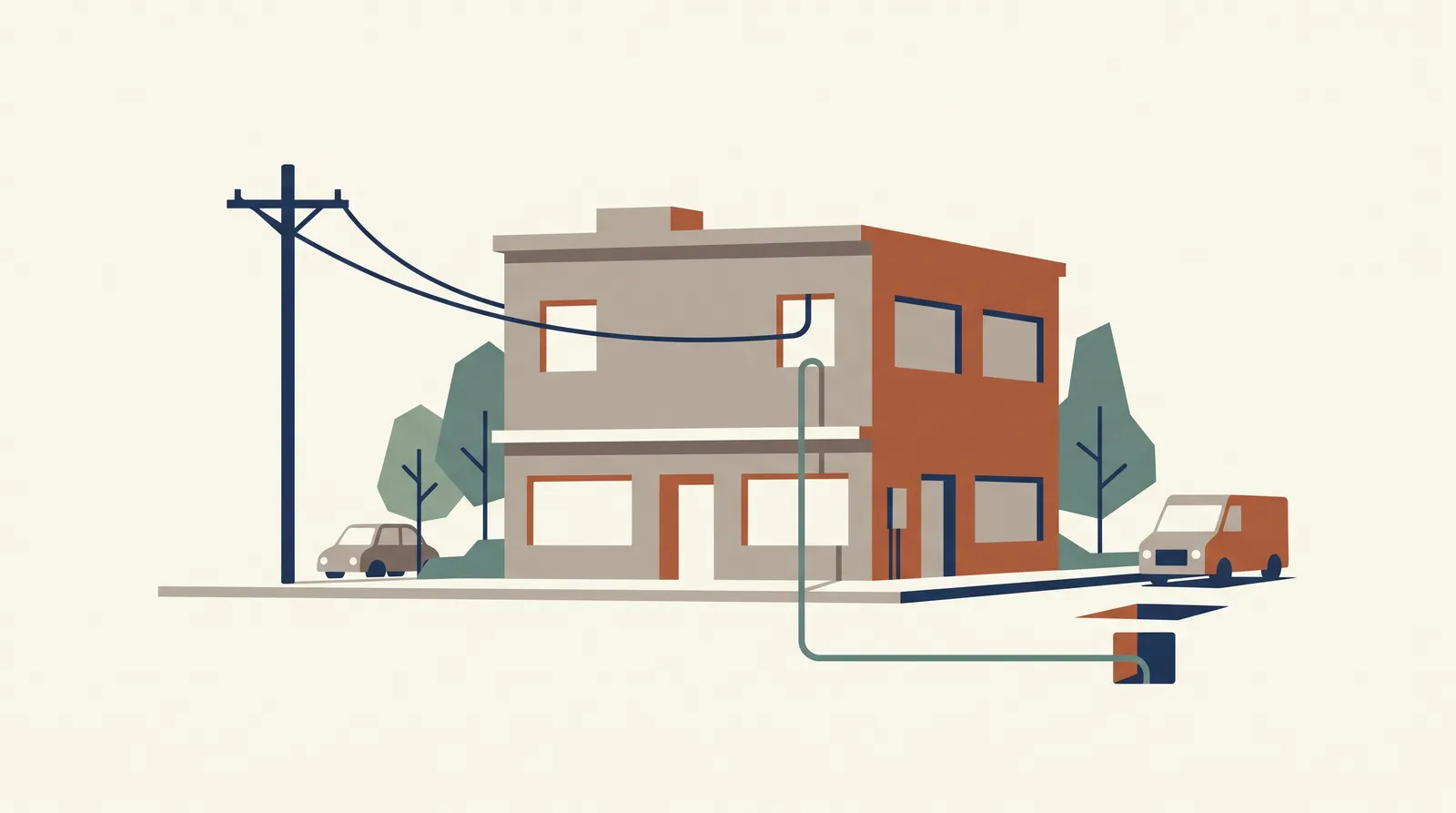
Every data centre I ever worked in had two of everything that mattered - two power feeds, two cooling paths, two telco services entering the building through two different pits, ideally on opposite sides of the street. Not because data centre people are paranoid. Because they’ve done the arithmetic on what an hour of downtime costs, and the second path always came out cheaper.
Now look at your own office. How many wires carry your internet? For almost every small business I visit, the answer is one. One connection, one supplier, one piece of street infrastructure between you and every cloud service your business now runs on - email, accounting, point of sale, phones if you've moved to VoIP. The modern small business has quietly become a thin client of the internet, while keeping the connectivity posture of 2009.
The backhoe doesn't care about your SLA
Here's the thing about that one wire: most of what kills it is physical and local. A contractor through a conduit. A pit flooded in a storm. A failed port in a node cabinet you've never seen. When it happens, your provider's status page will politely tell you a technician has been assigned, and the restoration estimate will be measured in days, not hours. I've sat in enough outage bridge calls to tell you that estimate is a hope, not a commitment.
The days don't fall kindly, either. Outages cluster around storms and civil works - exactly the weeks when your customers are disrupted too, and when the restoration queue ahead of you is longest.
While you wait, what does your business actually do? EFTPOS drops to "cash only". The accounting package is a login screen. The email that runs your quoting sits unread. You're not breached and nothing was stolen - you're simply closed, with the lights on. Availability is the leg of security nobody sells, and it's the one that takes small businesses offline far more often than any attacker does.
Different supplier, different technology
The fix is the data-centre principle scaled down to a shelf: a backup internet connection for the business - a second service - and the two words that make it work are different and different.
Different supplier, because two retail plans riding the same wholesale line is redundancy theatre - if both your services are NBN over the same fibre into the same node, one backhoe takes out both, and you've paid twice to fail once. I've watched an organisation discover this on big infrastructure: two "diverse" carriers whose paths merged in the same duct two streets away. Ask the boring question before you buy: does this second service share any physical path with my first?
Different technology, because that's what buys you independent failure modes. A fixed-line NBN service paired with a 5G service, or with a satellite service like Starlink, fails for unrelated reasons: storms that flood pits don't take down satellites, and tower congestion that slows 5G doesn't touch the fibre. Pick the pairing your location supports; the principle is the same.
And the entry-level version of this costs almost nothing. A 5G hotspot living in a drawer, tested once a month, with enough data to limp through a bad week, turns a multi-day outage into a ten-minute changeover. A router that can hold both connections and fail over automatically is a few hundred dollars more, and worth it the day nobody's there who knows which cable to swap.
The third option is a car
There's an even cheaper layer underneath all of this: know where you'd work if the office had no internet at all. Home. The accountant's spare desk. The café with the good back corner. If your systems really are cloud-based, a dead office connection is an inconvenience precisely to the degree you've thought about it beforehand - and a crisis to the degree you haven't. Write the answer into your run book and it stops being a decision you make angry - it's exactly the kind of disruption the government's free emergency management plan template asks you to think through, in 2026 as in any year.
What does the whole arrangement cost? A second connection runs somewhere between a strong coffee habit and a modest phone plan, per month. Hold that against one lost trading day - not a catastrophe, just one ordinary Tuesday where the EFTPOS says no - and the second wire usually pays for its year before lunch.
The data centres figured this out decades ago, and nobody who works in one would run production on a single feed. Your business is production. How many wires does it run on?
Sources
- Australian Government, business.gov.au, Develop an emergency management plan - retrieved 13 June 2026
- Red Bridge Cyber, perspective: Write the Run Book Before You Need It
- Red Bridge Cyber, perspective: The Third Word in the Definition of Security